AI Outreach and GDPR: What to Know
AI outreach that complies with GDPR: use explicit consent, transparency, data minimization, secure vendors, human oversight, and prompt opt-outs.

AI Outreach and GDPR: What to Know
AI-powered tools are changing how businesses handle outreach, but using them comes with GDPR challenges, especially when engaging with EU prospects. Here's what you need to know:
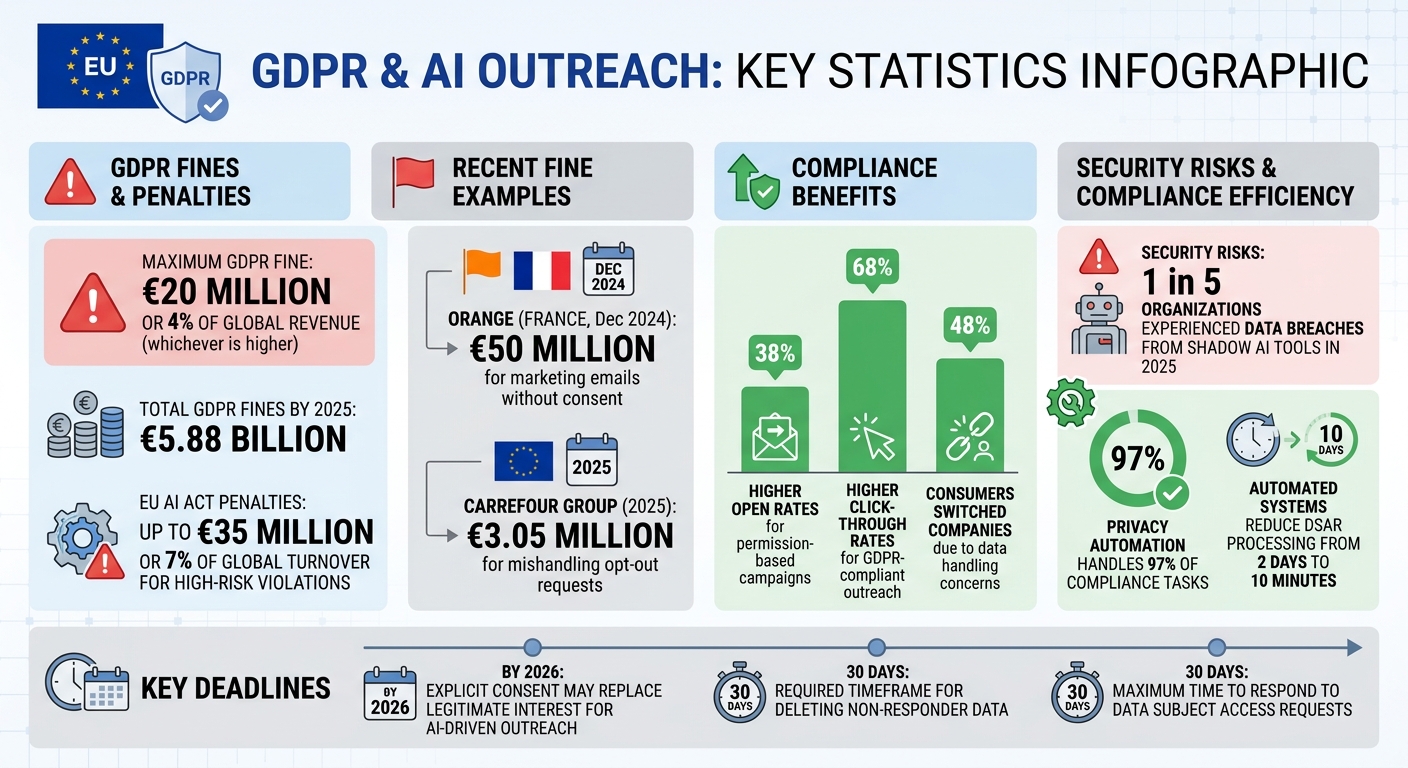
- GDPR Compliance Is Critical: Non-compliance can lead to fines up to €20 million or 4% of global revenue. By 2025, fines reached €5.88 billion.
- Explicit Consent: By 2026, explicit consent may replace "legitimate interest" as the legal basis for AI-driven outreach.
- Transparency Is Key: Inform prospects about data sources, usage, and their rights. Disclose when AI generates content.
- Data Minimization: Only collect necessary professional data, avoid irrelevant personal details, and delete non-responder data within 30 days.
- Security Risks: Avoid "shadow AI" tools and ensure vendors provide secure, GDPR-compliant infrastructure.
Balancing AI's capabilities with GDPR requirements ensures not only compliance but also better outreach performance. Campaigns that follow GDPR rules see up to 68% higher click-through rates.
GDPR Compliance Statistics and Fines for AI Outreach
The Intersection of AI and GDPR Requirements | Exclusive Lesson
sbb-itb-817c6a5
Common GDPR Challenges in AI Outreach
Using AI for outreach can make processes faster and more efficient, but it also brings new hurdles when it comes to GDPR compliance. These challenges often revolve around how AI tools handle data - collecting, processing, and acting on it. To stay compliant, it’s essential to understand and address these issues.
Missing Legal Basis for AI Messaging
One of the first hurdles is establishing a valid legal basis for processing personal data. Traditionally, B2B outreach leaned on the "legitimate interest" principle under Article 6(1)(f), which allowed contacting prospects for reasonable business purposes. However, this is changing. By 2026, the EU is expected to require explicit consent for AI-driven cold outreach, replacing reliance on legitimate interest [1].
Recent fines highlight the risks of non-compliance. In December 2024, French regulator CNIL fined Orange €50 million for sending marketing emails without proper consent [1]. Similarly, Carrefour Group faced a €3.05 million fine in 2025 for mishandling opt-out requests and violating data subject rights in marketing communications [1]. These cases underline the need for a well-documented legal basis.
Article 22 adds another layer of complexity. Fully automated decisions - like disqualifying leads or assigning pricing tiers - can violate GDPR unless there's human oversight [2][6].
"Your AI can draft, recommend, score, and suggest, but a human must review and approve before it matters" [2].
To navigate this, conduct a Legitimate Interest Assessment (LIA) for each campaign. This process involves documenting your purpose, proving the necessity of data processing, and balancing your interests against the privacy rights of prospects [6]. Without proper documentation, your legal basis could be invalidated.
Beyond having a legal basis, clear communication about how you use data is just as important.
Transparency and Data Subject Rights
Transparency is a cornerstone of GDPR compliance. You need to inform prospects about where their data comes from, the legal basis for using it, and their rights. This becomes tricky when AI tools pull data from multiple sources like LinkedIn or third-party services. Under Articles 13 and 14, you must disclose this information within a month of collecting the data - or at the first point of contact [6].
Many AI tools fall short here, as they often aggregate data without providing clear notices.
"The risk isn't the model, it's the operating model. Lists are compiled from mixed sources without a clear legal basis" [6].
The EU AI Act further requires you to disclose when prospects are interacting with AI-generated content. For example, if an email was written by AI, recipients must be informed [2].
Article 21 requires immediate action on opt-out requests. If a prospect asks to stop receiving communications, your AI system must suppress their details across all channels - email, LinkedIn, web forms, and more [6]. Failing to honor these requests promptly can lead to severe violations.
Additionally, you must handle Data Subject Access Requests (DSARs) within 30 days. If a prospect asks to see or delete the data you hold on them, your AI platform should have automated tools for retrieval and deletion. Manual processes simply don’t scale for high-volume outreach [2].
Besides transparency, it’s essential to limit the data you collect and ensure its security.
Data Minimization and Security Risks
The GDPR’s data minimization principle states that you should only collect data necessary for your purpose. However, some AI tools overstep by gathering excessive details - like browsing habits or personal information - that have little relevance to B2B outreach [2][1].
"Under the GDPR, the personal data you collect should be adequate and relevant to the purpose of its processing" [1].
Stick to professional data such as job titles, company names, and industries. Avoid collecting personal details that don't serve a clear purpose.
Data retention is another key area. Delete information on non-responders within 30 days [2][6]. Holding onto outdated data not only risks GDPR violations but can also lead to errors in AI-driven personalization, like referencing irrelevant or old details.
Security becomes a bigger concern when "shadow AI" tools - those used by employees without IT approval - enter the mix. In 2025, 1 in 5 organizations experienced data breaches due to shadow AI tools [2]. Using consumer-grade platforms, such as free versions of ChatGPT, can also expose prospect data to risks, as it may be used for model training [2]. Always ensure your AI vendor provides a Data Processing Addendum (DPA) that prohibits such usage.
Finally, cross-border data transfers add another layer of complexity. If your AI tool processes EU data on servers outside the European Economic Area, you must use mechanisms like Standard Contractual Clauses or secure an adequacy decision to stay compliant [6]. Neglecting these safeguards could lead to hefty fines and enforcement actions.
Solutions for GDPR-Compliant AI Outreach
Navigating GDPR compliance doesn't have to complicate your AI outreach. By applying practical and scalable measures, you can stay compliant while maintaining effective communication.
Establishing a Legal Basis for Prospecting
The first step to compliant AI outreach is having a documented legal foundation. For B2B outreach, legitimate interest under Article 6(1)(f) is often the go-to option. But this isn't automatic - you’ll need to conduct a Legitimate Interest Assessment (LIA) for each campaign. This process involves three key steps: identifying a valid business purpose, proving the necessity of processing, and balancing your interests with the prospect's privacy rights [7][6].
Make sure to document every part of your LIA. Include details like the business purpose, the professional data you're using, and the safeguards you’ve put in place. For example, if your campaign targets senior marketing roles at SaaS companies, note this in your LIA. Such precise targeting shows you're minimizing intrusion and strengthens your legal standing.
It's also critical to remember that GDPR rules can vary by country. In the UK, legitimate interest is broadly accepted for B2B outreach. However, Germany may require implied consent with stricter documentation, while Austria might insist on explicit consent for automated AI calling systems [3][8]. Before launching, scrub your contact lists against national opt-out registers like the UK's CTPS, Germany's Robinsonliste, or France's Bloctel [8].
Getting these legal foundations right sets the stage for transparent and compliant data practices.
Automating Transparency and Data Subject Rights
Transparency can be tricky, but automation makes it manageable. Start by embedding Article 14-compliant privacy notices in your initial outreach. A layered approach works well: include a brief privacy summary in your email footer or LinkedIn message, and link to a detailed "Prospect Privacy Page" that explains your data sources and legal bases [6].
When personalizing outreach using AI, always cite your sources. For instance, instead of saying, "I saw you're hiring", you could say, "Noticed on your company careers page that you're expanding your sales team." This kind of specificity builds trust and shows you're handling data responsibly.
The EU AI Act also requires AI systems to disclose their artificial nature upfront. A simple line like "This message was crafted with AI assistance" fulfills this requirement [8][6].
Automating opt-out handling is just as important. Train your AI tools to recognize opt-out language, whether it’s "unsubscribe", "not interested", or "remove me." Once flagged, your system should immediately update your CRM and suppress that contact across all channels - email, LinkedIn, web forms, and more [6][8]. Some businesses have cut Data Subject Request processing times from two days to just ten minutes using automation [2].
To avoid accidental re-contacting, maintain a centralized suppression list as your single source of truth. Sync this list with all third-party data providers. Permission-based campaigns often perform better, with open rates increasing by 38% and click-through rates by 68% compared to non-compliant outreach [1].
With transparency handled, the next focus should be on securing and minimizing data.
Implementing Data Security and Minimization Practices
To tackle excessive data collection, start by limiting what you gather. Stick to essential professional details like a prospect's name, job title, company, and business email [2][5]. Avoid collecting sensitive personal information that doesn’t serve a clear business purpose [5][3].
Set automated deletion policies to align with GDPR's storage limitation principle. For example, remove non-responders within 30 days of initial contact [2]. Keeping retention periods short reduces your risk exposure.
Map out your data flows with a Record of Processing Activities (RoPA). This should document where data enters (e.g., LinkedIn, web forms, purchased lists), how AI processes it, and where it’s stored [2][1]. Clear visibility into your data flows is crucial for compliance and security.
When working with vendors, ensure they use AES-256 encryption and hold certifications like SOC 2 Type II or ISO 27001. Using EU-hosted infrastructure can also simplify cross-border compliance [5][1].
Avoid using unsanctioned tools, often referred to as "shadow AI." Studies show that one in five organizations experienced data breaches through unauthorized tools in 2025 [2]. Always rely on enterprise-grade solutions with signed Data Processing Addendums (DPAs) that explicitly prohibit using your data for model training.
Finally, implement real-time email verification to maintain data accuracy. This not only supports GDPR's accuracy principle but also improves deliverability and reduces bounce rates, ensuring your outreach remains effective and compliant [2].
Evaluating GDPR-Ready AI Outreach Platforms
Key GDPR Features to Look For
When assessing a GDPR-compliant AI outreach platform, there are several critical features to prioritize. First and foremost, ensure the platform's Data Processing Agreement (DPA) explicitly bans the use of prospect data for vendor AI training purposes[2].
Look for certifications such as SOC 2 Type II or ISO 27001, as these indicate a platform's commitment to maintaining rigorous security standards[2][1]. Additionally, verify that the platform employs AES-256 encryption to safeguard data both at rest and in transit[1].
Automation is another key aspect. The platform should handle Data Subject Requests efficiently and ensure data is purged within 30 days as required by GDPR[2][1]. A centralized suppression list is also essential - it ensures that when a prospect opts out on one channel (e.g., LinkedIn), the opt-out is honored across all communication channels automatically[1].
For compliance with GDPR Article 22, platforms should offer Human-in-the-Loop (HITL) functionality, allowing human oversight of AI decisions, along with transparency tools for auditability[2][1].
Finally, pay close attention to where data is stored. Platforms using EU-hosted infrastructure make it easier to comply with cross-border data transfer regulations. With GDPR fines reaching €5.88 billion by January 2025[2][1], implementing these compliance measures is not just about avoiding penalties - it’s also about ensuring efficient and secure outreach practices.
How SalesMind AI Supports GDPR Compliance
SalesMind AI is designed to align with GDPR requirements, offering features that integrate seamlessly with compliance frameworks. For instance, the platform automates and centralizes the tracking of LinkedIn replies, responses, tags, and opt-outs, ensuring no prospect is contacted after opting out[9].
The platform also uses AI-driven lead scoring to focus on the most relevant prospects, supporting data minimization principles[9]. Alex Lossing, CTO at Slash, shared his experience:
"From the very first week, SalesMind AI boosted my productivity in lead prospecting by 10×"[9].
SalesMind AI enhances compliance by assigning unique IP addresses and randomizing action timing, with a minimum of five minutes between actions. Additionally, it schedules messages during local business hours to create organic communication patterns and reduce the risk of account flagging[10].
By automating follow-ups and lead tracking, the platform minimizes manual errors, ensuring that opted-out prospects are never contacted again. Rahul Pushkarna, Senior Advisor at Bounty Media, highlighted its impact:
"SalesMind AI has proven very useful to our sales team in reducing the massive pain points of manually tracking each and every lead interaction"[9].
With high ratings across platforms - 4.4/5 on Trustpilot, 4.7/5 on G2, and 5/5 on the Chrome Store - SalesMind AI continues to receive praise for its user-friendly interface and smart automation capabilities[9].
Conclusion
Sticking to GDPR rules can seriously boost AI-driven outreach. For example, permission-based campaigns enjoy 38% higher open rates and 68% higher click-through rates compared to outreach that ignores compliance rules [4][1]. These numbers clearly show that respecting data privacy doesn’t just protect you from penalties - it also makes your campaigns perform better.
And let’s not forget the risks. The fines are no joke. Under the EU AI Act, penalties for high-risk violations can climb to €35 million or 7% of global turnover [2]. But it’s not just about avoiding hefty fines - compliance fosters trust. In fact, 48% of consumers have switched companies because of concerns about how their data was handled [4][1].
Striking the right balance between AI and human input is key. Use AI for drafting emails or scoring leads, but always include human oversight to meet GDPR Article 22 requirements [2][8]. Best practices include implementing 30-day deletion policies for non-responders, automating Data Subject Requests, and always being upfront about AI usage [2][8]. Privacy automation tools can handle up to 97% of compliance tasks, giving your team more time to focus on building genuine connections [2].
FAQs
Does AI outreach to EU prospects require explicit consent?
Under the General Data Protection Regulation (GDPR), AI outreach to prospects in the European Union requires explicit consent when handling personal data. This consent must be:
- Clear: There should be no ambiguity about what the individual is agreeing to.
- Specific: Consent must relate to a particular purpose.
- Informed: Individuals need to fully understand how their data will be used.
- Revocable: People must be able to withdraw their consent at any time.
Ensuring your outreach aligns with these principles is crucial to avoid potential GDPR violations.
What should I disclose when an outreach message is AI-generated?
Being upfront about the fact that your outreach message is AI-generated can go a long way in building trust with your prospects. Transparency shows integrity and demonstrates that you value ethical practices. By acknowledging AI involvement, you also help maintain credibility in your communication, which is essential for fostering positive relationships.
How can I honor opt-outs and deletion requests across email and LinkedIn?
To respect opt-outs and deletion requests, ensure recipients have straightforward and accessible options to withdraw consent or request data deletion. For email communications, always include an unsubscribe link or provide a reply option. Make sure to process these requests within 10 business days. On LinkedIn, halt outreach immediately after someone opts out, and confirm your tools are equipped to manage consent and handle data deletion properly. Regularly update your contact lists to reflect these changes without delay.